Why Your Black Activewear Stops Matching After a Few Washes - and How to Keep the Set Aligned

Quick Answer: Black is not one color - it is a dye recipe, and different fabrics take it differently. Nylon, polyester, and cotton hold black dye with different fastness, so identical-looking pieces diverge on different schedules. Heat, sunlight, detergent alkalinity, and mechanical abrasion each shift black in a different direction - toward gray, brown, or blue-green. Keeping a monochrome wardrobe aligned means washing all your blacks the same way and, honestly, retiring them together.
The pieces that fade first are the ones that get washed most, which is rarely the same as the ones worn most.
And once black shifts hue rather than just lightening, no product brings it back.
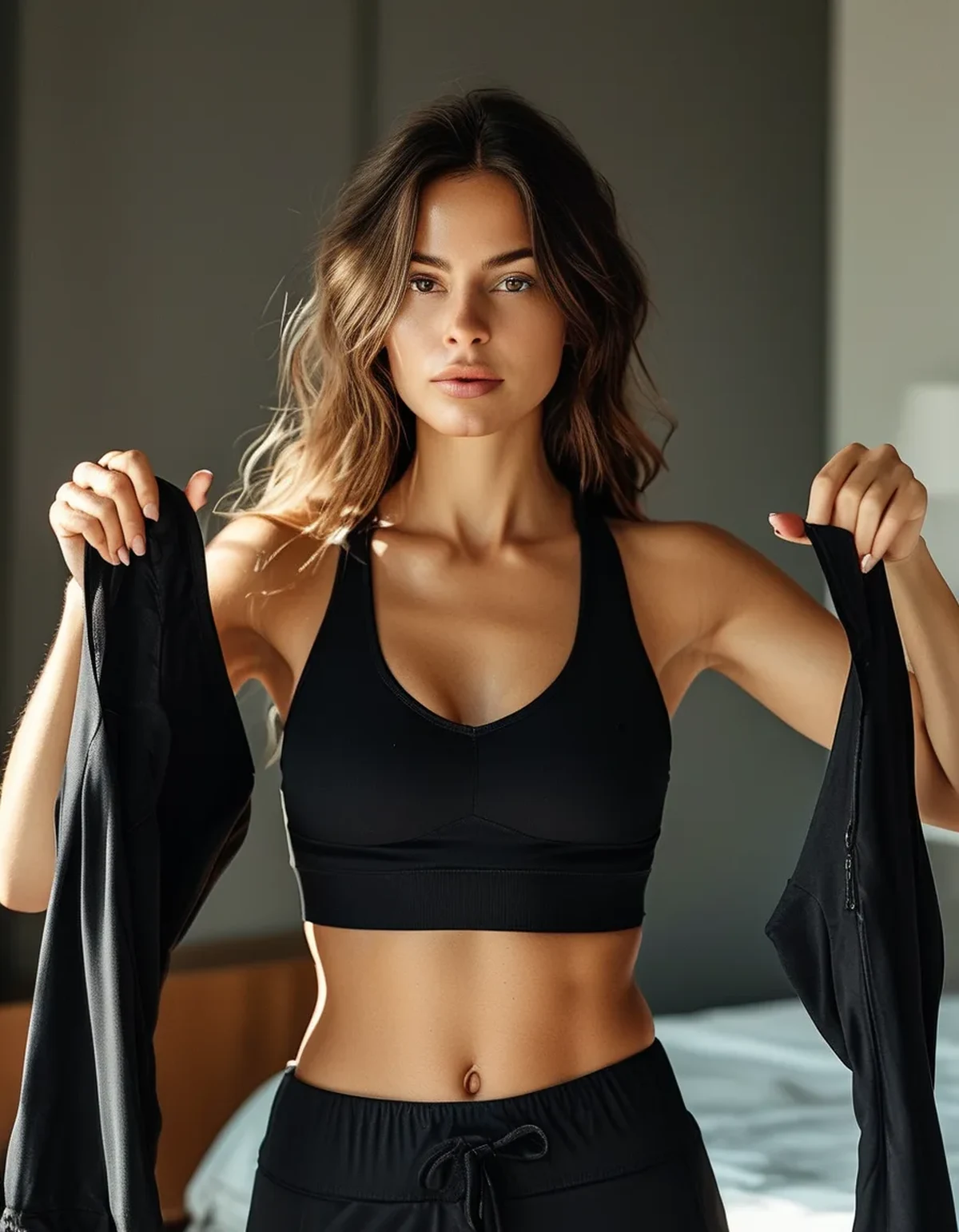
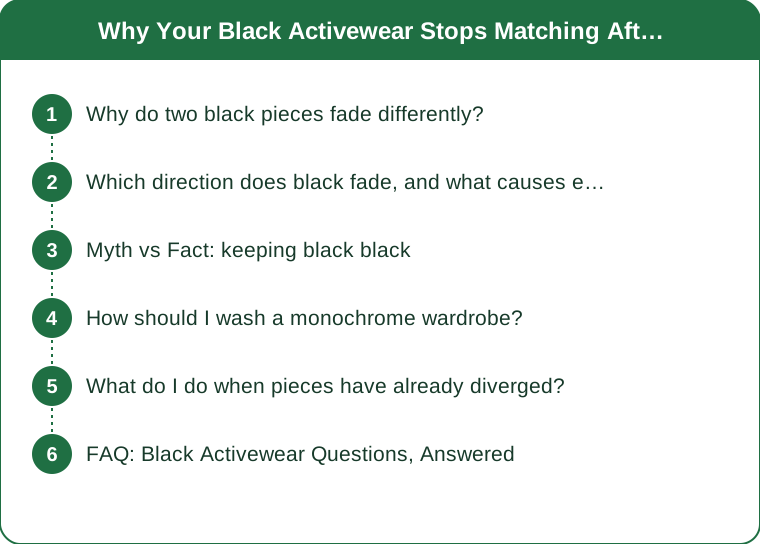
Why do two black pieces fade differently?
Because they were probably never dyed the same way.
Fiber determines dye class. Polyester is dyed with disperse dyes at high temperature and holds color exceptionally well. Nylon takes acid dyes and is more vulnerable to sunlight and chlorine. Cotton uses reactive dyes and fades fastest of the three. A polyester legging and a nylon top can both be jet black on day one and be visibly different by month four.
Knit density matters. A dense knit has more dyed material per square inch and reads darker for longer. A thin, stretchy knit shows the pale core of stretched fibers sooner.
Elastane does not take dye well. Fabrics with high elastane content often have the elastane dyed separately or left undyed, which is why heavily stretched areas - knees, seat, waistband - lighten first.
So the divergence starts at the mill. All you are doing with laundry is deciding how fast it becomes visible.
Which direction does black fade, and what causes each?
Black rarely just gets lighter. It shifts, and the shift tells you the cause.
Toward gray: mechanical abrasion and detergent residue. Fiber surfaces get scratched and scatter light, and undissolved detergent leaves a haze. Most common on high-friction areas.
Toward brown or rust: UV exposure. Sunlight degrades certain dye components faster than others, and the remaining ones read warm. Line-drying in direct sun is the fastest way to get there.
Toward blue or green: chlorine and some oxidizing agents. Pool water, chlorinated tap water, and any bleach-adjacent product.
Toward washed-out and blotchy: high-temperature washing and drying. Heat is the most damaging single variable and it affects both the dye and the elastane simultaneously.
A useful diagnostic: hold the piece next to a new black item in daylight, not indoor light. Indoor lighting hides hue shift almost completely, which is why you only notice at 10 a.m. in a parking lot.
Myth vs Fact: keeping black black
Myth: Washing in cold water is enough. Fact: cold is necessary and not sufficient. Abrasion, detergent chemistry, and drying method matter as much as temperature. Cold water plus a hot dryer is a wash.
Myth: Adding salt or vinegar sets the dye. Fact: this applies to some natural-fiber dyeing processes and does essentially nothing for finished synthetic garments. Vinegar is useful for removing detergent residue - which does help appearance - but it does not fix dye.
Myth: Black-specific detergents restore color. Fact: they generally contain optical agents that reduce visible fading by masking it, plus milder surfactants. They slow the process; they do not reverse it. Worth using, not worth expecting miracles from.
Myth: Dyeing at home fixes a faded set. Fact: home dye works reasonably on cotton and poorly on polyester and nylon-elastane blends, which is most activewear. Results on athletic fabric are usually blotchy and the elastane may not survive the hot water required.
Myth: Fading is about how much you wear it. Fact: it is mostly about how many wash cycles it has been through. A piece worn twice between washes fades at half the rate of one washed after every wear.

How should I wash a monochrome wardrobe?
The goal is uniform treatment, so pieces age at the same rate.
- Wash all blacks together, in one load, on cold. Same water, same detergent concentration, same agitation. Separating them into different loads is what causes divergence.
- Turn everything inside out. Abrasion happens on the outer surface; inside out moves the damage where it does not show.
- Use half the detergent you would normally. Excess detergent does not rinse out of synthetics and produces the gray haze.
- Skip fabric softener entirely. It coats fibers, dulls surface reflection, and destroys moisture-wicking.
- Air dry indoors, out of direct sunlight. The dryer and the sun are the two fastest paths to hue shift.
- Wash less often where you reasonably can. A top worn for a light session can be aired and worn again.
A quarter cup of white vinegar in the rinse every few loads removes residue buildup and restores some depth to the surface. It is the one home remedy that genuinely does something.
What do I do when pieces have already diverged?
Some paths forward, from best to worst.
Re-pair them. A charcoal top with a black legging reads as an intentional tonal look, especially with texture variation - which is the actual foundation of a good monochrome outfit anyway. Two shades of black with different surface finishes looks considered; two shades that are almost identical looks like an accident. Push them further apart rather than trying to bring them back.
Demote by context. The faded pieces become the home-workout set; the newer pieces handle anywhere you will be photographed. Fading is far more visible in daylight and on camera than it is in a gym.
Replace in pairs. When one piece of a set is done, both are effectively done as a set. Budget for it that way.
Buy same-fabric sets going forward. Matching top and bottom in the same fabric composition from the same brand fade together. That is the only reliable way to keep black aligned long-term.
And heading into fall, the newly relevant question is layering: a slightly warmer-toned faded black under a true black jacket looks deliberate. Two cool blacks at slightly different depths do not.
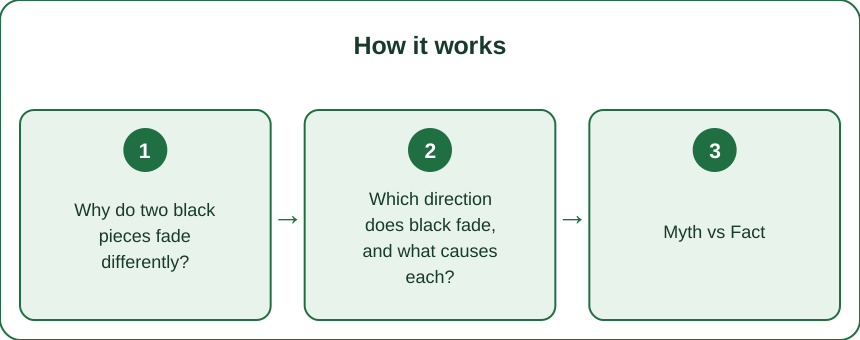
FAQ: Black Activewear Questions, Answered
Does hanging vs folding matter?
For color, barely. For shape, yes - hanging heavy knits stretches shoulders. Fold activewear.
Is it worth buying more expensive black?
Sometimes. Higher-quality dyeing and denser knits do hold color longer, and better brands more often list fabric composition clearly so you can match sets. But wash habits close most of the gap.
Why does my black look fine at home and faded in photos?
Camera sensors and daylight both reveal hue shift that warm indoor lighting hides. If you are photographing your outfits, check them in daylight first - the camera will.
TL;DR:
- Different fibers hold black differently - nylon, polyester, and cotton diverge no matter what you do.
- The shift direction tells you the cause: gray means abrasion, brown means sun, blue-green means chlorine.
- Wash all blacks together, cold, inside out, half the detergent, no softener, air dry indoors.
- Wash count, not wear count, drives fading. Airing out a lightly worn piece genuinely helps.
- Once diverged, re-pair them deliberately with texture contrast rather than trying to restore them.
Monochrome only looks expensive when the tones are either identical or clearly different. The awkward middle is what washing habits decide.
See It in Motion
Seen here: Super High Waist Embossed Yoga Leggings with Inner Pocket — shop it on bubblelime.com
Keep Reading
This article is for general informational and styling purposes only. Fit, sizing, and product availability may vary.