Why Do Monochrome Outfits Need One Hardware Color, Not Two?

Quick Answer: Monochrome removes color contrast, so whatever is left carries all the visual weight — and hardware is usually the only thing left. Two metal tones in a tonal outfit create the one point of contrast in the whole look and put it somewhere unflattering, which is why the outfit reads as slightly off without anyone being able to say why.
You got the shades right. The blacks match. It still looks unresolved.
Check the zipper pull against the shoe eyelets.
This is general information, not medical advice.

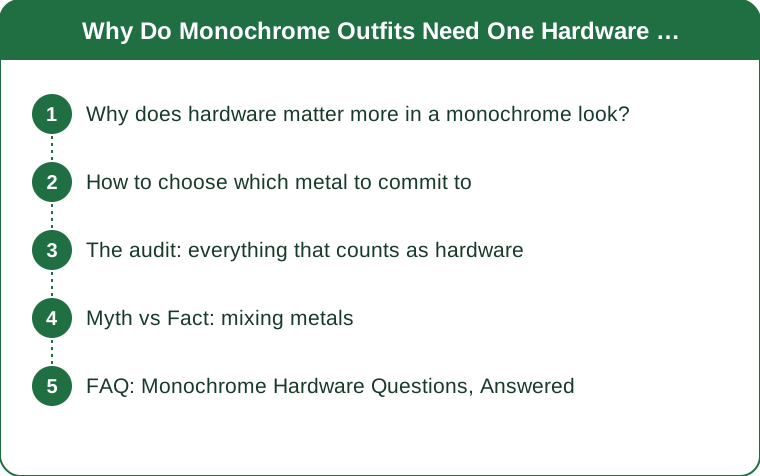
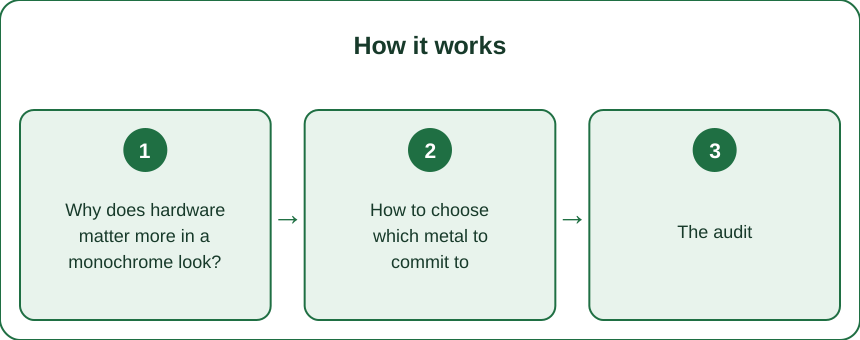
Why does hardware matter more in a monochrome look?
Because contrast has to go somewhere, and you removed all the other places it could go.
In a mixed-color outfit, the eye has plenty to organize — a top against different trousers, a jacket against both. Hardware is a small detail inside a busy visual field, and mismatched metals genuinely do not register.
Strip the color contrast out and the hierarchy inverts. In an all-charcoal look, the only high-contrast elements on your body are the zipper pull, the buckle, the eyelets, the logo plate, and possibly a watch. Those become the punctuation of the entire outfit.
When they match, they read as a deliberate line of detail — the eye connects them and the outfit looks composed. When they do not, the eye keeps stopping at each one separately, and the look feels busy despite being a single color. That impression of busyness in a monochrome outfit is almost always hardware.
Is this the same reason logos break monochrome?
Exactly the same mechanism. A contrast logo is a high-contrast element in a field with no other contrast, so it takes over. Hardware is the version of this that nobody thinks to check.
How to choose which metal to commit to
Pick the one that appears on the piece you cannot change, then match everything else to it.
Usually that is the shoes. Eyelets and lace hardware are fixed, you own fewer pairs than tops, and shoes anchor the bottom of the look. If your main trainers have silver eyelets, silver is your tone.
If shoes are neutral or hardware-free, the next anchor is the jacket zipper, since outerwear is the largest hardware surface and the most visible.
From there:
- Silver and gunmetal sit naturally with cool-toned monochromes — true black, charcoal, slate, cool grey. They are the safest default in activewear because most technical hardware ships in them.
- Gold and brass work with warm monochromes — chocolate, camel, olive, warm taupe — and read as more deliberate. They also demand more consistency, because gold against silver is a more visible clash than gunmetal against silver.
- Black hardware is the third option and the most underrated one. Matte black zippers and buckles on a black or charcoal outfit remove the contrast problem entirely by removing the contrast. It is the cleanest solution available and increasingly common in technical outerwear.
What if two pieces I love have different metals?
Wear them with a third color in the outfit so the contrast has company, or keep them for non-monochrome days. This is a genuine constraint of tonal dressing rather than a rule to work around.

The audit: everything that counts as hardware
More than people expect. Run through it once and you will not need to again.
- Zipper pulls and zipper teeth. Teeth matter as much as pulls on an open jacket, and they are often a different finish than the pull.
- Drawcord tips and toggles on hoods and waistbands.
- Shoe eyelets, lace tips, and any midsole hardware.
- Bag hardware — clasps, D-rings, zip pulls, and the feet on the bottom of a gym bag.
- Watch case and band hardware, which is the largest single piece of metal most people wear.
- Water bottle lid, if you carry it in your hand for the whole walk to the studio. It is in the outfit whether you counted it or not.
- Logo plates and rivets, particularly on waistbands and back pockets.
- Jewelry — the one people do count, and often the only one.
The realistic standard is not perfection. It is the three or four largest pieces agreeing: shoes, jacket, bag, watch. A small mismatched drawcord tip is invisible. A gold watch against silver shoe eyelets and a gunmetal zipper is three tones on one body, and that is what reads as unresolved.
Myth vs Fact: mixing metals
Myth: Mixing metals is fine now, so this does not apply. Fact: Deliberate metal mixing is genuinely a valid styling choice — in outfits with enough going on to support it. Monochrome is specifically the context where it stops working, because there is nothing else for the eye to do. The rule is contextual, not universal.
Myth: Nobody notices hardware. Fact: People rarely notice it consciously and reliably notice the effect. The common feedback on a mismatched tonal outfit is that something looks cheap or slightly off — which is the perception the mismatch produces, not the material quality it is being attributed to.
Myth: Black hardware is a compromise. Fact: Matte black hardware is the most technical-looking option available and it solves the problem completely on dark monochromes. It is a first choice, not a fallback.
Myth: It only matters in photos. Fact: Photos amplify it, because the flash or bright light makes metal the brightest thing in frame. But the effect is present in person — it is just quieter.
Myth: Matching hardware means matching finishes exactly. Fact: Tone matters far more than finish. Brushed silver and polished silver coexist without issue; silver and gold do not.
FAQ: Monochrome Hardware Questions, Answered
Does this apply to non-black monochromes?
More, actually. Lighter tonal outfits — cream, oatmeal, soft grey — have even less internal contrast, so hardware carries more of the visual weight. Gold on cream is a particularly visible pairing, in both directions.
What about a metallic that is neither silver nor gold?
Rose gold and bronze behave like gold for these purposes — warm tones that clash with cool ones. Treat them as a warm commitment.
Can I change hardware on a piece I already own?
Zipper pulls are replaceable and it is a common alteration; lace tips can be swapped by changing the laces entirely. Riveted logo plates generally cannot. It is usually cheaper to reassign the piece to non-monochrome outfits.
Does the rule apply to sports watches with a black case?
A fully black watch is the easiest possible case — it disappears into a dark monochrome outfit and reads as neutral against a light one. Black cases with a silver bezel ring are the ones that count as silver.
How much does this actually matter?
It is a small effect that happens to sit in the place where monochrome outfits are judged. Getting the shades right is 80% of a tonal look; hardware is a meaningful part of the remaining 20%, and it is the part that is free to fix.
TL;DR:
- Monochrome removes color contrast, so hardware becomes the only contrast in the outfit.
- Anchor to the metal on your shoes, or the jacket zipper if shoes are hardware-free.
- Silver and gunmetal for cool tones, gold and brass for warm, matte black to remove the problem entirely.
- Audit the big four — shoes, jacket, bag, watch — and ignore small drawcord tips.
- Mixed metals are a valid choice elsewhere; monochrome is the context where they stop working.
The blacks matching is the hard part and you already did it. The zipper pull is the part that decides whether anyone can tell.
This is general information, not medical advice.
Keep Reading
This article is for general informational and styling purposes only. Fit, sizing, and product availability may vary.